Real-time Healthcare IoT Monitoring Analytic Solution ...
This solution is leveraging on the IoT technology and real-time processing architecture in monitoring healthcare data from patients and alerting clinician in hospital when patients required special attention. The developed Healthcare Analytic Platform consist of functionalities to provide analytic features, alerting the clinician and APIs to expose analytics as a services. The platform is developed with the goal of efficient data analytic processing patient-profile and contains different models of patients for dynamic information to be analyzed. Besides, the platform should be able to cop with large amount of IoT sensor data arriving in real-time, at the same time able to process it with efficient algorithms.
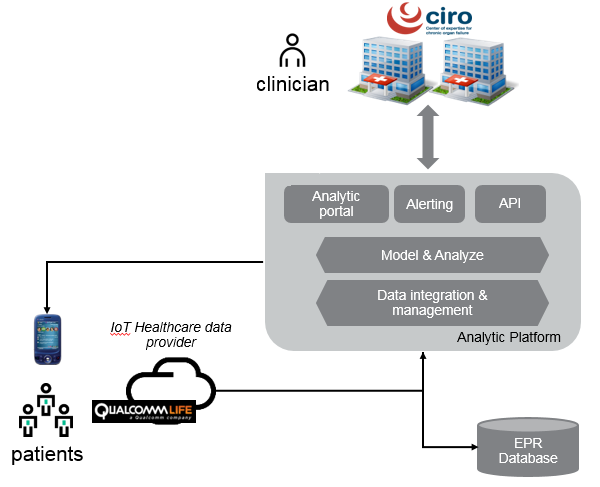
The figure below indicates the specification and functions in developing the Healthcare Analytic Platform. It contains a Real-time Analytic Engine, which is developed using Spark technology. The data that has been captured using IoT devices will flow into the platform in real-time manner. The solution consists of Advance Analytic models, which are able to recognize different Human Activities, which are defined as Walking, Sitting, Standing, Walking-Up, Walking-Down and Sleeping.
The machine learning algorightms especially SVM and Random-Forest Classification are used to study the sensor data captured from IoT device for each of the patients. The type sensor data included the heart-beat rate, movement data in X-direction, Y-direction and Z-direction, skin temparature data and environment data. In-combination of the patient data, such as age, gender, weight, height, the machine learning algorithms create specific models for every patient in detecting their on-the-fly motion.
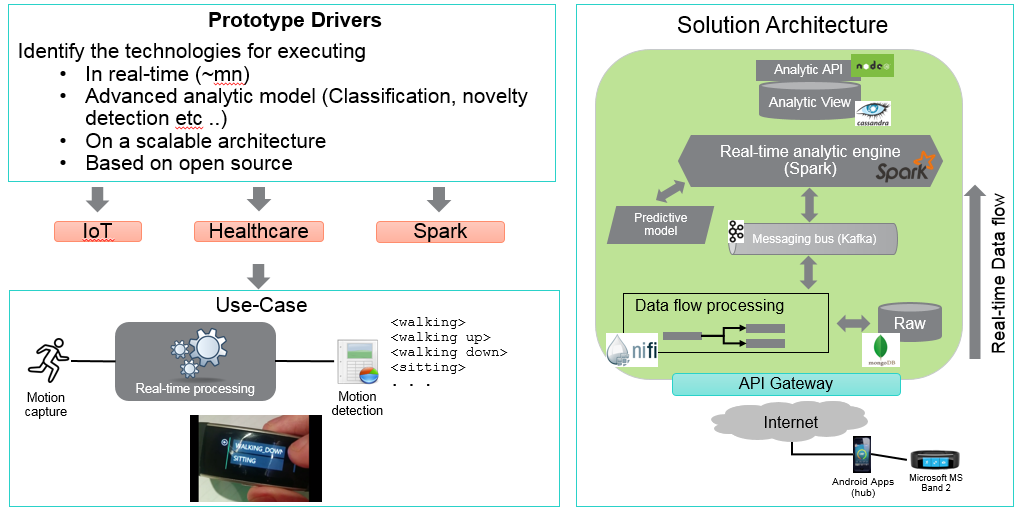
Multiple Spark jobs running in parellel to process the received sensor data and detecting the motions of each patients in real-time manner. Leveraging on Hadoop-Spark technology, the solution is scalable in future by just adding additional processing server node and increase additional memories when hitting the performance issue by serving more and more patients. Without changing a single line of code and involving a series of heavy software development processes, the solution is able to scale up seamlessly by just increasing the computational power and storage.